unnamed

Fan into flame the gift

Fan into flame the gift…

On a Sunday in early October, Mike Neelley and I went into Skagit County Jail together for our weekly services. Five men gathered around a stainless steel table cemented into the floor. We began with a prayer and then I passed out photocopies of 2 Timothy 1:6-14 – the passage on the gift of God.

I invite someone to read the first verse:

“For this reason I remind you to fan into flame the gift of God which is in you through the laying on of my hands.”

I offer a brief introduction by stating that God has gifts for all of us– spiritual gifts. These gifts are different from natural abilities, like being artistic, perceptive or a good communicator.  Spiritual gifts are distinct from learned skills like carpentry, welding, or auto mechanics. They include healing, prophesy, identifying evil spirits that afflict people, faith, and many others.

“Maybe some of you already know of a gift God has given you,” I suggest, looking around at blank faces.

“Or, maybe some of you still don’t know if God has given you a spiritual gift, and you’d like to receive something.”

The men seem to resonate with this option. I go on to share how these gifts enable us to become actively involved in God’s liberating work in the world,

I share how exercising a spiritual gift, like praying for someone to be healed or sharing a prophetic impression requires faith, which means taking risks. I ask someone to read the next verse:

“For God has not given us a spirit of fear, but of power and love and discipline.”

Hearing these verses in the heart of the jail, with the TV blaring a football game suddenly made me feel vulnerable. I think I was then and there experiencing the kind of fear or timidity we’d just read about. The next verse seemed to expose and directly address the underlying issue:

Therefore do not be ashamed of the testimony of our Lord or of me His prisoner, but join with me in suffering for the gospel according to the power of God, who has saved us and called us with a holy calling.”

We talk about how natural it is to feel ashamed to believe in God’s liberating actions and of Jesus himself. You can feel like a fool believing in an invisible God.

Yet in the face of this Paul writes as an inmate himself, urging people not be ashamed. After all Jesus has saved us, and we need saving. Still when we respond to his call we do enter into a kind of suffering, which the apostle acknowledges.  But Christ Jesus “abolished death and brought life and immortality to light through the gospel.”

Suddenly I remember that the men hadn’t seemed aware that they had received a spiritual gift. I suggest that Mike and I would love to ask the Holy Spirit to reveal each person’s spiritual gift, and that we could gladly ask God to give new gifts.

The men all seemed eager to for whatever was going to happen next. Mike and I looked at each other and began to go for it, taking turns to speak prophetically over each man around the table.

Each man seemed to soak up the words of affirmation that Mike and I offered, agreeing with the gifts that we identified or spoke over them. We could see new hope ignited, there in this place of bleakness where negativity, harsh labels and curses abound.

Only one man joined us in “P pod”—a Mexican American guy with stars tattooed on his cheeks, barely visible under long curly black hair parted in the middle.  He is a man of deep conviction, born of suffering through years in prison.

Mike and I were moved by how easy it was to identify people’s spiritual gifts in the jail setting, and how precious and welcomed God’s perspective is among those who feel downtrodden.

We wrap up our time with each group by encouraging the men to step our in faith—fanning into flame their gifts. We encourage them to not let fear paralyze them, but God’s power, love and disciple.

Paul’s final words seem the perfect charge: “Guard, through the Holy Spirit who dwells in us, the treasure which has been entrusted to you.”

Mike and I find ourselves being deeply encouraged by this Scripture and our experience with the men. I share this message at Tierra Nueva’s service that day, and the work continues.

For further reflections on the gifts of the Spirit, read “Guerrilla tactics: signs, wonders, justice and mercy,” chapter nine in Guerrilla Gospel: Reading the Bible for Liberation in the Power of the Spirit.

Share this post on Social Media:
Follow the TheoMisc Blog:
Follow WTC Theology on WordPress.com
Morocco

Dying Every Day – To Live!

Dying to our own agendas…

The last day of our trip to Morocco overlapped with the Pope’s visit. We had just completed the final module of our Certificate in Transformational Ministry at the Margins with 40 French-speaking Sub-Sahara African migrants. I was tired but excited after having spent time visiting house churches and engaging with serious missional leaders from ten or so different countries.

That day, Saturday, March 30 the Pope arrived for a two-day visit.  Security was tight, and only people on pre-approved lists could attend the special smaller gatherings where he was speaking. Gracie and I weren’t on any lists. Students and faculty from the ecumenical theological seminary where we were teaching who were on the list gathered excitedly, ready to travel together by bus to one of the venues.

While I was waiting around, hoping to somehow be able to go, Gracie came over and asked me to help her pray for a French woman who had had a chronic illness for over 25 years. Christian, one of the African pastors who was on the list had also told me that he would rather take us to pray for a man from one of his house churches whose legs were totally paralyzed than see the Pope. He had told us that he’d likely be coming by later that afternoon to take us to this young man’s house. I wasn’t in the mood to pray for anyone- tired from four days of straight teaching and ministry in French.

Jesus’ journey to the feast in Jerusalem in John 5 did come to mind though—the story where he stops at the sheep gate and prays for a man paralyzed for 38 years. Stopping and praying for this man appeared Jesus’ priority over anything else.

Getting my will in alignment with Jesus’ priorities rather than seeing the Pope or being a tourist in Morocco felt like a kind of death. A Scripture from Romans 8:36 came to mind, which I’m finding myself called to remember and come under throughout each day, every day.

Just as it is written, “for your sake we are being put to death all day long; we were considered as sheep to be slaughtered.”

I reluctantly agreed to pray with Gracie for the French woman, as students and faculty left excitedly to get on the bus to see the Pope. We saw the Spirit move to bring healing and freedom– a beautiful experience! As we were wrapping up we got a call from Christian, the house church pastor from Cameroon, telling us he was on his way to take us to pray for the paralytic.

He flagged down a taxi and we headed out to one of the marginalized neighborhoods where many migrants find inexpensive housing (see video link below). The neighborhood had been cleansed of petty criminals—which normally abound, days prior to the Pope’s visit. We followed Christian through streets and alleys until we came to the paralyzed man’s house.

Dying to liveAs we entered the smell of urine was strong. The 26-year-old man with paralyzed legs lay on a bed- immobile. His name is Jesus! He’s a worship leader from Afrique Central (Central African Republic) who had been unable to move his legs at all for over a year. We prayed for him and saw his excitement and faith build as his back pain left and he began to move his feet and legs. He insisted on attempting to get up, without out help, and was able to stand.

I think of the verse right before Romans 8:36:

“Who will separate us from the love of Christ? Will tribulation, or distress, or persecution, or famine, or nakedness, or peril, or sword?”

We left feeling like we were experiencing the verse following– Romans 8:37.

“But in all these things we overwhelmingly conquer through Him who loved us.”

As we left Jesus’ room, Christian’s five-year-old daughter tugged on his arm, telling him God was telling her to pray for a blind Morocco Muslim woman who sat by the entrance to Jesus’ apartment. Christian did an about face—returning with his daughter to the woman and her friend. He explained what God had told his daughter. The two women were deeply touched, kissing the girl’s cheeks. The little girl boldly stretched out her hand and prayed for the woman’s eye to be opened in Jesus’ name. If anyone could reach these two Moroccan women, this little girl seemed like the perfect missionary.

Surrendering to Jesus’ will involves dying to our own agendas. “Being put to death all day long” might mean relinquishing our own plans, comfort, security—whatever needs to die in favor of following a higher calling. Abundant, resurrection life awaits us.

Share on Social:
Follow WTC Theology's TheoMisc Blog:
Follow TheoMisc on WordPress.com
Levison Holy Spirit

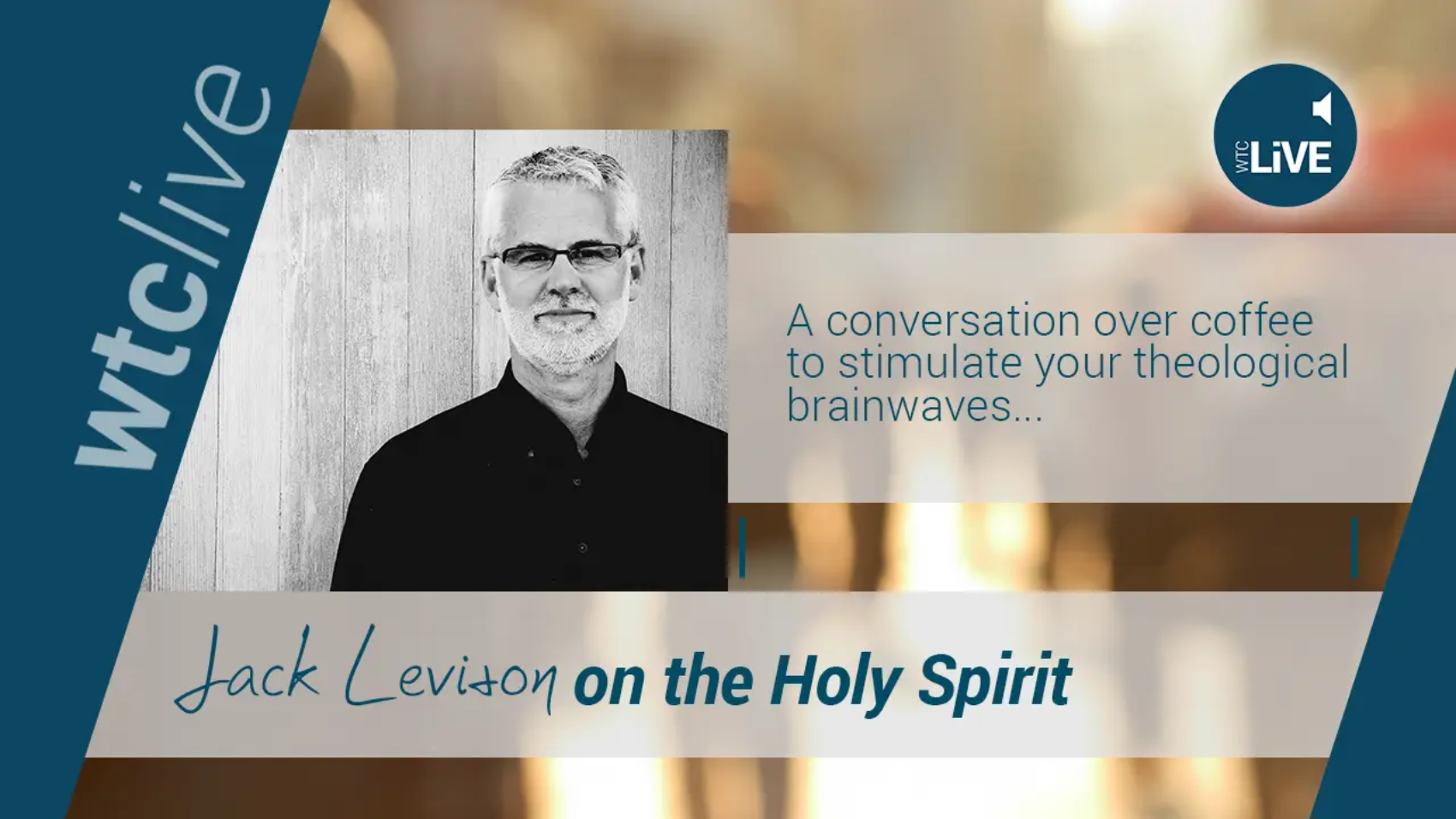
Jack Levison on the Holy Spirit

In this WTCLive episode, hosted by Dr. Matt Lynch, Dr. Lucy Peppiatt, and Nick Crawley in a coffee shop in Bristol Old Testament scholar Jack Levison discusses his own journey in discovering more about the Bible and the Holy Spirit.

Guest:

Jack LevisonJack Levison
Southern Methodist University

Jack holds the W. J. A. Power Chair of Old Testament Interpretation and Biblical Hebrew at Perkins School of TheologySouthern Methodist University. Raised in a small tract house in Levittown, New York, Jack left to attend Wheaton College, where his Greek professor regaled him with stories of Cambridge University. At Christ’s College, Cambridge, Jack received the Fitzpatrick Prize for theology and was awarded a College Scholarship. When he returned from England to pursue doctoral studies at Duke University, Jack fell in love with a divinity student, Priscilla Pope, alongside of whom he now works at SMU.

Jack is an internationally recognized scholar, whose books have received wide acclaim. Scot McKnight, author of The Jesus Creed, characterized Filled with the Spirit as “the benchmark and starting point for all future studies of the Spirit.” Walter Brueggemann hailed it as “inspired.” Eugene Peterson called Fresh Air: the Holy Spirit for an Inspired Life “a rare and remarkable achievement.” Phyllis Tickle calls him “a brilliant and spirited theologian,” and N. T. Wright notes that Jack’s “account of the holy spirit–and what the spirit can do for whole churches, not just individuals!–is mature, seasoned, challenging, and wise.”

Jack has received many fellowships and grants from the National Humanities Center, the Lilly Fellows Program, the Louisville Institute, the Alexander von Humboldt Foundation, the Rotary Foundation, the International Catacomb Society, and the National Endowment for the Humanities. He recently directed, with Jörg Frey, an interdisciplinary, international research project on The Historical Roots of the Holy Spirit and is founding editor of a scholarly book series, Ekstasis: Religious Experience from Antiquity to the Middle Ages.

Jack’s books and teaching have a global reach. He has lectured around the States, as well as in Belgium, Canada, England, Germany, and Scotland. He has been an Honorary Visiting Lecturer at the University of St. Andrews, Scotland, and a Von Humboldt Fellow at Ludwig Maximilians Universität in Munich, Germany. Several of his books have been translated into Spanish, Korean, and German.

Share on Social:
Bible for Life

Bible For Life

Nick CrawleyBy Nick Crawley, MA – Church Leader, founder and director of Bible for Life.

Nick is an Anglican clergyman with over 25 years experience of church leadership in London, Harare (Zimbabwe), Sheffield, and Bristol. He is a qualified Banker and Investment Analyst and was awarded an MA with merit in Christian Theology from the University of Bristol. He is married to Dr. Lucy Peppiatt the systematic theologian and author, and current Principal of Westminster Theological Centre. They have four sons.

What is Bible for Life?

William Tyndale translated the Bible into English in order that ‘the boy who drives a plough (would) know more of the scriptures’. And he was executed for it!Today, almost 500 years after his death, it’s easy enough to pick up an English Bible, but our secular C21st society seems to know next to nothing about what it actually says.

One of the reasons for this is that the Bible is in practice a difficult book to understand.

I love the Bible. I’ve never found any book remotely like it. It describes the life of the most remarkable man who ever lived and who has influenced human history and life more than anyone other human being. It also has what has been called a ‘ring of truth’ about it – a deep resonance that it is communicating the most genuine truth a person can ever encounter.

Over the past ten years I have been working at finding ways to make both the books of the Bible and its message more accessible for interested, but busy people.

Bible for Life, (BfL), is a ministry that helps genuine enquirers get to the heart of the message of the different Bible books. It is built on a number of principles.

1) Studying a whole book at a time

First, the majority of Christians seem to read the Bible like a newspaper, turning to their favourite sections and not reading much else. While this is better than nothing it almost always misses the author’s main point. BfL approaches each book as a unit, written by an author in a specific context to recipients in a different context. The context is crucial because it directly influences the meaning of the text. Every sentence has been written for a reason and contributes directly to the meaning of the book and its application.

2) Using the resources available on the internet

Second, since our lives, (and especially the lives of those under thirty), are now completely orientated around the internet, Bible teachers must find new ways and media for communicating Biblical truth directly to smart phones, laptops and tablets.

3) Catering for different levels of engagement

This leads to the third feature of BfL; The Menu. The material on the site is presented for the visitor to engage with the material in different levels. Using a meal format the visitor can have a 5 minute ‘Taster Course’, through watching a short video, studying an image, reading a summary or engaging with questions. A deeper engagement through other ‘products’ is available in the ‘Starter Course’, while in the ‘Main Course’ there is a “commentary” and a serious study of the imperatives of the book for the committed disciple of Jesus. The ‘Dessert Course’ is more open-ended touching on academic issues, special studies, prayers and tools for the church pastor. At the end of each course there are questions relating the key issues in the book to contemporary C21st life and issues.

4) A varied approach to suit different personalities

The fourth BfL feature is the variety of learning approaches to suit the different ways we engage with and respond to texts. As well as visual, audio and textual media there are different ways of responding what we encounter such as ‘challenge’, ‘enquiry’, ‘inter-reaction’ and ‘response’. BfL works to provide these, and this is where the related discipleship coaching is important.

5) A coaching and mentoring tool

I engage with a number of people on a monthly basis coaching them in their engagement with the Bible. The strategy throughout is to coach them to engage with the Bible for themselves. A month seems to be the right period of time for a person to engage at a deep level with one book of the Bible. As Jesus said, “The measure you use is measured to you.” Those that engage most, get most.

6) Completely free!

I look forward to the day when there are hundreds of different internet based strategies and tools for helping apprentices of Jesus unlock the dynamic of Scripture. BfL is one such tool. All the material is completely free. I hope you find it helpful. Why not visit the site now and see for yourself.

Share on Social:
Augustine of Hippo

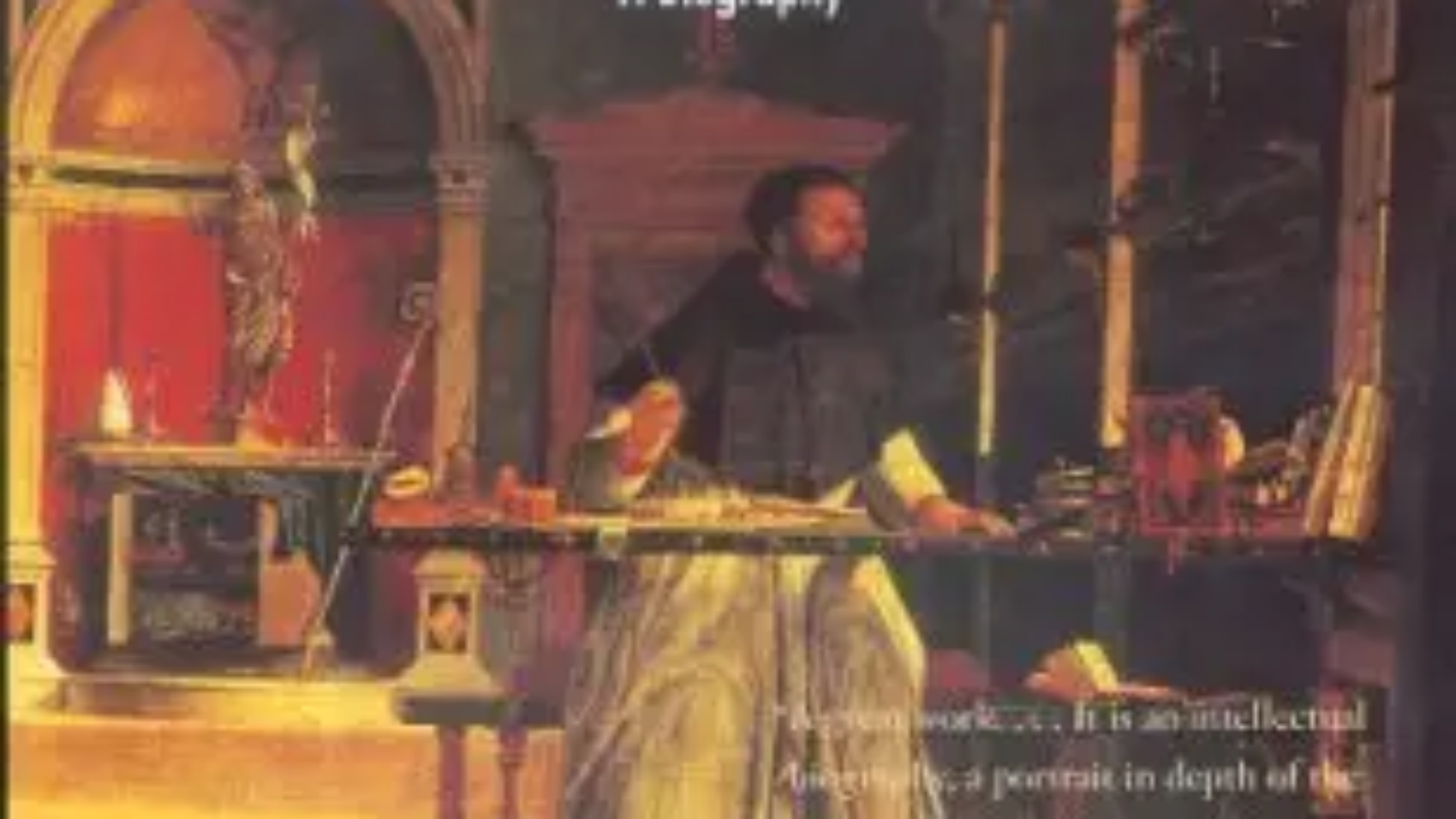
Review of Peter Brown, ‘Augustine of Hippo: A Biography’ by Steve Watts

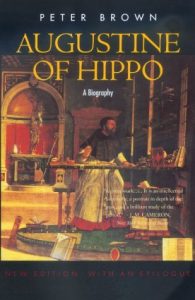
Peter Brown, Augustine of Hippo: A Biography, Forty-Fifth Anniversary Edition (University of California Press, 2000, originally published in 1967), pp. 548.

Steve Watts profileSteve Watts teaches Church History and History of Spirituality at WTC. He is passionate about the creative relationship between Christian belief and culture. Steve completed his PhD in Mediaeval History at the University of St Andrews, and believes there is much to be gained today from an informed understanding of the Medieval Church.

Augustine of Hippo…

There is admittedly something strange about posting a review of a book whose first edition was published fifty years ago. Even its second edition will soon be turning twenty. My initial thought was that Peter Brown’s classic biography of Augustine (d. 430), bishop of the North African port city of Hippo Regius, might provide one way of engaging with the surprisingly little-marked five-hundredth anniversary of the Reformation’s “first year”.[1] Augustine had, of course, departed for greener pastures over a millennium before Johann Tetzel first cast his unseemly shadow upon the backwater town of Wittenberg. But as students of the Reformation will know, Augustine’s writings and––perhaps more importantly––his authority carried no small weight during the proceedings. Both Roman Catholics and the Magisterial Reformers were determined to keep the venerable Church Father on “their side”.  And was it not, after all, a cantankerous Augustinian friar that is credited with causing all that fuss in the first place?
Augustine of Hippo book coverMartin Luther was Augustinian in more than one sense, however. Evidently he belonged to an order that among other things followed a rule traditionally attributed to the North African bishop. But he was also Augustinian insofar as aspects of his thought were shaped, or perhaps empowered, by encountering Augustine’s work directly––especially the latter’s anti-Pelagian writings. Yet it is a further sense of Luther’s Augustinianism that perhaps best explains why Augustine is important not only for grappling with the legacy of the Reformation but also for understanding the very trajectory of the western intellectual tradition.

Luther, simply put, was Augustinian in the same way that pretty much any other medieval person was Augustinian. The most succinct way of explaining why, is two-fold: 1) Augustine was a prodigious thinker and voluminous writer, whose breadth and depth of erudition were unmatched during his lifetime and well beyond; and 2) the collapse of Roman civilization in the West produced conditions in which his writings, and those of a select number of others, would be ascribed a remarkable degree of authority. In the latter case, it was as if Augustine’s opinions were like so many stones chosen from among the imperial rubble, now repurposed to provide a foundation upon which a discernibly medieval cultural architecture could arise. As a result, right through the Middle Ages to the Reformation and then well beyond, his influence can be detected in so many areas of philosophy and theology, from human psychology to Just War theory and from soteriology to ecclesiology.[2] Such, then, is Augustine’s undeniable importance within the western tradition. And yet, however ironically for an author of the highly personal Confessions, this very “importance” has often succeeded in obscuring the man himself.

Augustine has suffered from a way of retelling history that latches onto great figures of the past, such that their monumental personalities come to dwell in some metaphorical pantheon to which all students must display at least a passing awareness. So grand in the imagination, looming in all their authoritative grandeur over the course of history, he––like too many others––has become prone to caricature. And this is why Peter Brown’s study is so valuable. Brown seeks to understand Augustine, not as the monumental “Great Church Father of the West”, but as a North African pagan-turned-bishop who grappled with fundamental questions of human existence as the sun began its rapid descent on the western Roman Empire. In short, Brown offers a person in place of a façade.

It is the second edition of Brown’s book that I have had the great pleasure of reading. The first edition was composed in the 1960s and by Brown’s later admission was discernibly influenced by such sixties’ concerns as power, psychology, and sociology––though, interestingly enough, not so much by sex. That text actually remains unrevised in the present volume. Brown explains in the foreword that he thought it best not to modify what he had written some thirty-odd years’ earlier. Too much scholarship had been produced in the intervening years to incorporate it feasibly. And, even more importantly, there was the substantial discovery of a number of Augustine’s letters and sermons in the interim that had shed new light on his pastoral activity. These had the result of softening Brown’s perception of the bishop, leading him to doubt his earlier judgement that Augustine’s personality had progressively hardened with age.

And then there is the perspective that comes from experience. When Brown first published the book he was already an accomplished, if relatively junior, scholar. In the following decades, his reputation would only continue to grow as a historian of the highest order. He has been recognized for decades now as one of the foremost authorities on religious culture in Late Antiquity (dating roughly, in his estimation, from the mid 3rd to the early 8th century)––a field he has done much to define at the expense of the periodization known in impolite society as the “Dark Ages”. On the basis, then, of the intervening scholarship, the discoveries, and his own thirty years’ worth of experience, Brown chose to add two substantial chapters (“New Evidence”; “New Directions”) to the end of the original work. Considering the subject matter, this is entirely fitting. Toward the end of his life, Augustine also cast his mind back upon his previous works and issued his own Retractions.

Brown charts the course of Augustine’s life, from his birth as Aurelius Augustinus in Thagaste, a town in Roman North Africa, now Algeria, to his death in Hippo Regius (“Royal Port”), during the Vandal siege of the city. He generally follows the lead of the Confessions when covering his subject’s first decades. Augustine is an exceptionally bright student, who, while not being the most virtuous of young men, was nevertheless able to gain both an excellent education and, finally, an impressive teaching position in Milan. Along the way, his restless spirit led from one philosophical or religious system (at the time, there was not much of a difference) to another until it finally found its rest in a garden, sobbing in surrender to the God of his mother Monica.

Following Augustine’s conversion, Brown continues to trace a historical trajectory but increasingly devotes chapters to major literary offerings (The City of God; On Christian Teaching), controversies (Donatism; Pelagianism), and fundamental aspects of Augustine’s thought (“people of God”; “origin of grace”). Throughout, Brown’s lucid prose carries the reader across a cultural landscape that is at times both strange and eerily familiar.

There are too many important revelations in the biography to enumerate here, so I’ll just choose one that might be of some interest: a contextual rendering of Augustine’s fascination with sexual desire.[3] As Brown points out, in the Confessions it is not Augustine’s pre-conversion sex-life, but that episode as a youth in which he and his friends steal pears for the sheer joy of it that continues to haunt him. Indeed, relative to the heroic asceticism of some of his peers, who lived in the shadow of the martyrs’ self-renunciation, Augustine was a moderate when it came to sex. His sermons show a surprisingly sympathetic concern for the love lives of ordinary married people. The more ascetically-minded had imagined Adam and Eve as chaste angels, with sex being but a product of the Fall. Augustine, on the other hand, envisioned Adam and Eve as engaging in a kind of pure sexual intimacy, flowing from perfect friendship. The trouble, from his perspective, was that only a shadow remained of that ideal, now haunted and haunting by an often uncontrollable lust. So then, while Augustine positively acknowledges the importance of sex in the lives of his married congregation, he nevertheless continues to attend to it as both the evidence of, and the means by which, Adam’s guilt is passed down through the generations. Not any more palatable to a “sexually liberated” modern audience, perhaps, but hardly evidence that Augustine is the prime mover behind Christian sexual repression as he is too often misrepresented.[4]

Augustine’s fascination with “the pear episode” might seem evidence of an all-too-sensitive conscience, made all the worse for it being forged into a cynical doctrine of human incapacity. But Brown will not allow us so convenient a way out. He points to Augustine’s attentiveness to the fact that for all the goodness in the world––and he does acknowledge it!––human beings, even babies at the breast, have more than a habit of enjoying things that, on a better day, the watching world acknowledges to be wrong, even evil. That is to say, we so often do the things we know we ought not to do. The human will, in Augustine’s view, is incapable of seeking its own good without help.

It is, therefore, on the basis of experience that Augustine concludes that human beings, whatever their best efforts and intentions, are fundamentally incapable of attaining fullness of love and life without receiving God’s unmerited grace. This underlies so much of Augustine’s thought, especially his participation in the principal controversies that dogged his pastoral and theological career. In his view, Donatists abused the grace of God by setting themselves up as a “perfect” church, counter to the “traitorous” Catholic church in North Africa. Similarly, Pelagius denied the gift of grace as a result of his calls for a more ascetically “perfect” Christian, insofar as he believed that human beings were naturally endowed with the capacity. Pelagius, it could be said, speaks fluently to the liberal mind––but he could not have been a pastor, and was clearly not a parent. And yet, in the bitterest of ironies, these conflicts over the nature of grace were too often marked by its absence.

Where Brown’s initial edition falters, his later additions typically offer a satisfying remedy. There is a little too much of the bishop at the expense of the pastor, too much of the Neoplatonist at the expense of the Christocentric theologian. His chapters on the Confessions and On Christian Teaching are at turns both illuminating and frustrating. The former suffers from the aforementioned imbalances, missing the broader pastoral implication of the work––a stunning testament to God’s gracious redemption of human frailty, as given by a rising star who would rather air out his dirty laundry before the watching world than bask in the glow of his achievements. The latter identifies Augustine’s educational platform but not its intended theological significance––a loving knowledge, learned and taught. But these criticisms do little to take away from the greater whole, which is simply masterful.

Peter Brown’s biography of Augustine is, therefore, a faithful representation of its subject matter in content and in form. Like Augustine, Brown is less interested in the heroic, in the monumental. He recognizes that the truth is in the details, laboured over and attended to. His book offers nuance, not as a show of cleverness, but for the sake of empathy. You do not need to like Augustine, but Brown will make sure that you have come some way in understanding him. The result, in the last analysis, is both an excellent introduction to Augustine and a superb example of historical scholarship. I could not recommend this book more highly.


[1] The degree to which this is true––at least in North America––is a story for another time.

[2] Don’t just take my word for it, see https://plato.stanford.edu/entries/augustine/#Leg

[3] Brown develops this side of Augustine in greater depth in his landmark work The Body and Society: Men, Women, and Sexual Renunciation in Early Christianity, but his most recent analysis––in the chapters of the second edition––casts Augustine in a more favorable light.

[4] See Stephen Greenblatt’s recent article in the New Yorker as perhaps the most recent example of this unfortunate phenomenon: https://www.newyorker.com/magazine/2017/06/19/how-st-augustine-invented-sex. It should be noted that Greenblatt is neither a historian of Late Antiquity nor a scholar with expertise on Augustine. He mostly works on Shakespeare.

Share on Social:
Madigan - Medieval Christianity

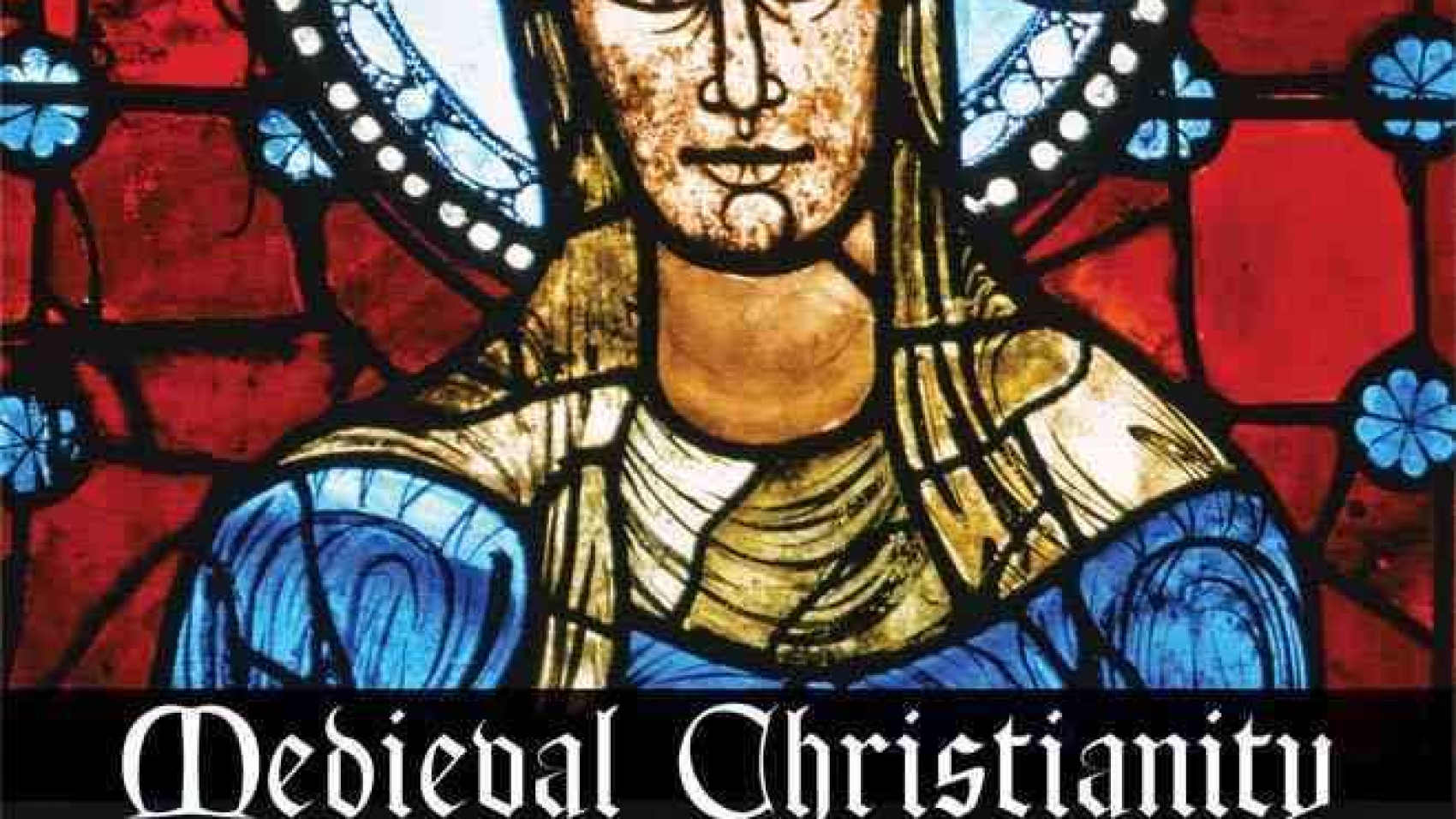
Review of Medieval Christianity: A New History – Kevin Madigan

Kevin Madigan, Medieval Christianity: A New History (Yale University Press, 2015). 544 pages.

Steve Watts profileDr Steven Watts teaches Church History and History of Spirituality at WTC. He is passionate about the creative relationship between Christian belief and culture. Steve completed his PhD in Mediaeval History at the University of St Andrews, and believes there is much to be gained today from an informed understanding of the Medieval Church.

Why bother with medieval Christianity?

In an (apparently) increasingly secular West, where the adjective ‘medieval’ is most often employed in the public forum as an intellectual swearword. Why even ask the question? Judging from the narrative both explicitly and implicitly expounded in the wider culture, is not the medieval world and its dominant religion simply a relic of a funereal, ignorant past from which the children of the fifteenth and sixteenth centuries were reborn and from which the daring young men of the eighteenth and nineteenth centuries were enlightened?

As is often the case with such totalizing accounts, however, a different picture emerges when one pays attention to the details. For how is it that this morass of superstitious ignorance give birth to a remarkable crop of universities? How could a society apparently hampered by technological backwardness give rise to such towering monuments of architectural excellence as the gothic cathedrals and the rich symbolism inscribed into their frames and illustrated upon their walls? How could an apparently close-minded theocracy produce such landmark developments in jurisprudence as the emphasis on intention and gaining a fair hearing before a jury of your peers? Indeed, the more one attends to the medieval period––that sprawling millennium stretching from roughly 500-1500––the more one is confronted by its importance in the formation of the western world and the numerous cultures which it has impacted. In short, the Middle Ages are important. And that means the same is true of the Christianity that coursed through its veins. As Kevin Madigan points out in his Medieval Christianity: A New History, by the early middle ages “the church was the single institution that cut across… lives political boundaries, and ethnic divisions” (xvii). The Middle Ages may not have been “an age of faith”, as is commonly supposed, but it cannot be understood without the faith so closely associated with it.

So then, why a new history of Medieval Christianity? Madigan justifies his contribution on the basis of the “important new scholarly developments” in the field in the four decades and counting since R. W. Southern’s landmark Western Society and the Church in the Middle Ages (1970). By incorporating these developments into what has become something of a standard account, he shines light on number of subjects that were overlooked in earlier scholarship (notably women’s history), of particular resonance to the geopolitical present (Christians interactions and perceptions of Jews and Muslims), and misconceived in the popular imagination (the Crusades / for an example of which see: http://www.historytoday.com/jonathan-phillips/crusades-complete-history).

Madigan’s book offers a narrative account that follows a broad chronological trajectory along the more-or-less traditional periodization of ‘early’ (600-1050), ‘high’ (1050-1300), and ‘late’ (1300-1500). It does diverge from this path from time to time, but only to address broader themes, such as the often––but not always, as Madigan reminds us––harrowing treatment of Jews by their Christian neighbours. As such, we have accounts of “the Means of Christianization”, of “Saints, Relics, and Pilgrimage”, and “Parochial Life and the Proprietary Church”, alongside descriptions of the rise of monasticism, heresy, and the schisms of the later middle ages. The vast majority of the touchstones of medieval religion are therefore present and accounted for.

At its best, the work offers the student or non-specialist a more nuanced grasp of such developments as the rise of the papacy, which was generally inspired more by reform than sheer megalomania (though in the person of Gregory VII it is unclear where one began and the other ended), and the conflicts that quickly arose within the Franciscan order when Francis of Assisi’s followers emerged out from under their founder’s uncompromising shadow. Also welcome is the attentiveness to the importance of women in medieval Christianity. Typically left as afterthoughts in major histories of medieval religion, Madigan makes sure to include them in “virtually every chapter of the book”.  He also navigates some of the more contested areas within the historiography of the past few decades, such as the validity of “popular religion” (that is, distinct from literate or clerical religion) as a historical category and the purpose and extent of the medieval inquisition (not to be confused with the Spanish Inquisition, which––let the reader understand––the reader may not have expected). In the latter case, let us just say that the histrionic presentation of Bernard Gui in the film adaptation of Umberto Eco’s The Name of the Rose is sorely mistaken. On a number counts, then, the book can be considered a success. It is clearly written, generally well organized, and offers a good deal of exemplary accounts to furnish the narrative with personality.

Madigan’s book, however, is not without its problems. As a number of reviewers have already pointed out, this is really a history of western medieval Christianity. It remains most closely tied to England, Italy, France, Germany, and––to a lesser degree––Spain. Scandinavia goes almost unmentioned and the same is substantially true of eastern Europe. There is little mention of Ireland, Scotland, and the Netherlands. More problematically, Madigan’s claim to incorporate recent scholarship is not always borne out by the research upon which he depends. Indeed, the book often relies on books that are many decades old, and it comes to some conclusions (such as the authorship of the Augustinian rule) that are already outdated. The result is that while some topics are relatively flush with “new scholarly developments”, others seem strangely tied to the past.

And just as there is a geographical imbalance, so there is also disparity in its chronological scheme. The lack of material on the late middle ages, which is only a few chapters long and is populated by much that does not fall within the stated chronology, is perplexing. Perhaps a subsequent edition might trim the book’s first chapters (which deal with the early centuries of Christianity in a manner not especially helpful for understanding the medieval Church) in order to provide a better treatment of a subject more directly relevant to the book’s central concern.

Finally, and perhaps the most substantial objection, is that the book does not offer enough opportunities for the student or non-specialist to expand their knowledge further. It is not always clear what sources or even scholars lie behind some of the positions given in the text. Moreover, while a narrative account is a helpful way to tell the story of the Middle Ages, the book misses something of the broader currents or mentalités (that is, how people thought about the world) that are characteristic of a religious culture so different from what we find in the West today. What about the Church’s response to death and suffering? What of its need, especially in the twelfth century and beyond, to organize, clarify, and synthetize wisdom––both old and new? What of the continuing and ever-changing resonance of the accounts of the first disciples of Christ in the reformations of its religious life? Answers to these kinds of questions, in my view, would help to explain rather than just to describe what was central to the various ebbs and flows of medieval Christianity.

To conclude, then. On the book’s front cover, the eminent scholar John Van Engen asserts that “this will undoubtedly be the fundamental narrative account of medieval Christianity for the next generation”. For the reasons noted above, I am not so sure. To be clear, Madigan has done a great service, particularly in light of the sheer scope of the task. One thousand years of Christianity (and then some) is a massive task and is only becoming more unwieldy as the scholarship continues to mount. But from the perspective of this reviewer, the book would be better received by students and non-specialists as a transitional work. It gives a sense of direction––more confidently in some places than in others––but does not constitute a place of arrival, not at least when compared with Southern’s earlier work. Perhaps that is simply the state of our understanding of medieval Christianity. However odd it might sound to twenty-first century ears, medieval Christianity is not a closed book. Its pages are continually being opened and poured over. Sometimes its contents are newly discovered, more often they are re-interpreted. Perhaps this continued interest reflects a growing suspicion that the narratives that we have been led to believe do not hold up to closer scrutiny. Madigan’s work certainly points in this direction. It is only a matter of whether one heeds the words so famously heard by Augustine in the garden: “Take up and read”.

Share on Social:
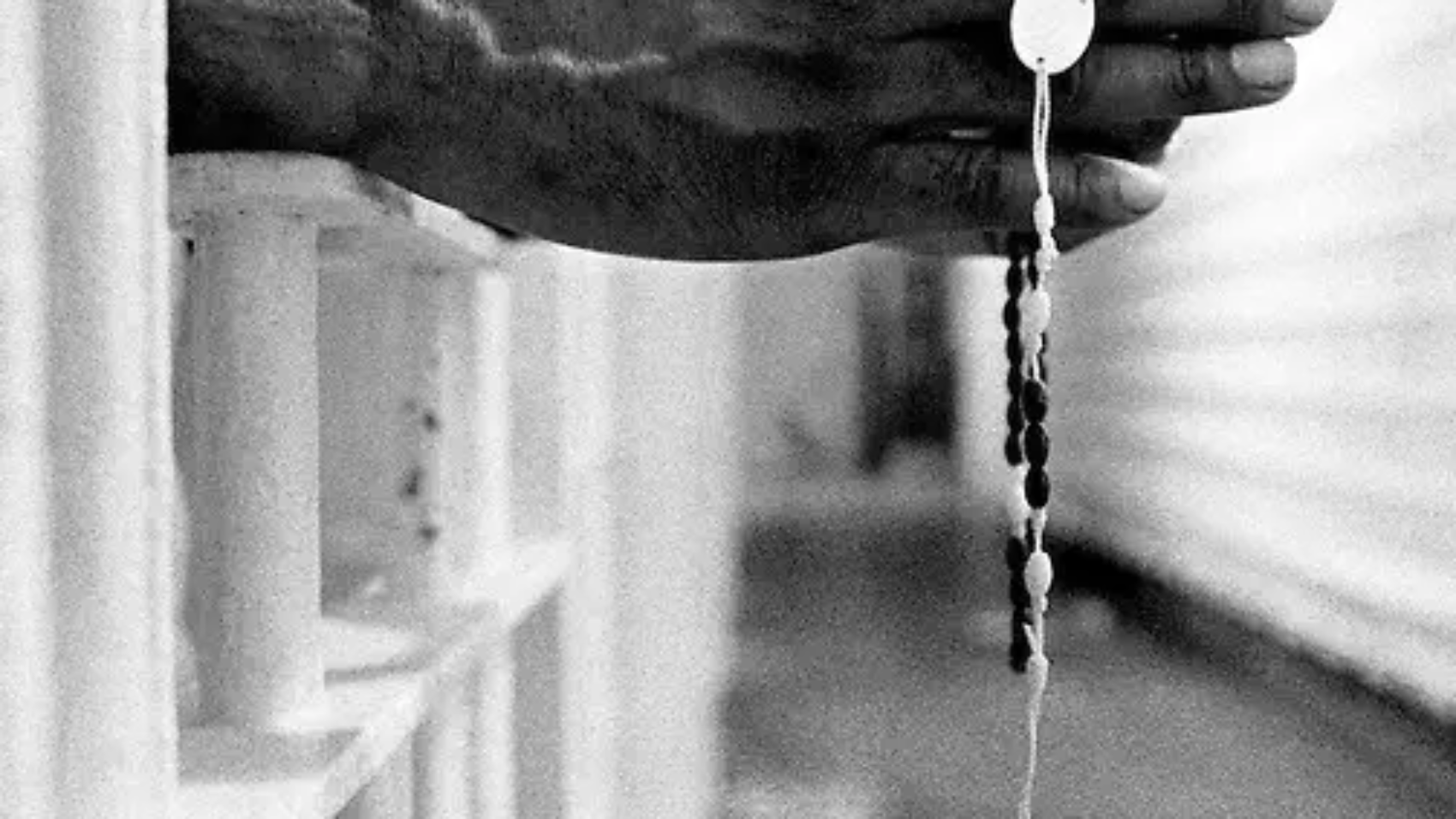
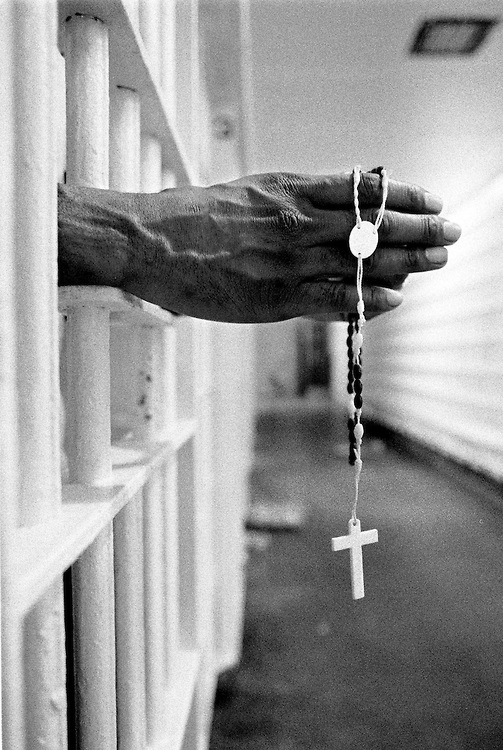
An inmate with a jail issued cross inside the segregation unit at Pitchess Honor Rancho, one of the ten different units that comprise the sprawling Los Angeles County Jail system which houses 21,000 inmates, the world's largest jail population.

A Fresh Look at Jesus’ Final Judgment Parable

Bob EkbladBob Ekblad has spent 25 years in international mission and is particularly passionate about working with the poor and ethnic minorities, as well as teaching on Mission and Social Justice.

To read more from Bob and to find out about his work, visit his website here.

A judgment parable…

Jesus’ parable of the judgment of the nations is often presented in ways that associate our treatment of anyone who is hungry, thirsty, a foreigner, naked, sick and imprisoned as synonymous with how we treat Jesus. Many Scriptures clearly call us to care for the poor, excluded, immigrants and prisoners. But numerous details in this parable suggest a different interpretation.

Jesus here teaches on the future judgment of non-Jews (the nations=ethnos), whom he commissions his disciples to evangelize and make disciples of before he departs (see Matthew 28:18-20). This parable is not about the judgment of nation states as institutions (though they will be judged), but about Jesus’ future response to how people treat his followers who go out spreading the word.

In this parable the King, who is also a Son of the Father in Heaven, returns and is enthroned. He calls non-Jews together and like a shepherd he separates sheep from goats. He says to the sheep, identifying himself as their shepherd:

“Come, you who are blessed of my Father, inherit the kingdom prepared for you from the foundation of the world.”

“For I was hungry… thirsty… a stranger… naked… sick… imprisoned” and “you gave me food… drink… hospitality… prison visits.”

These “righteous” don’t understand when they had done this for him, this Son of Man– the shepherd King. They hadn’t recognized him or made the associations he names.

“The King will answer and say to them, ‘Truly I say to you, to the extent that you did it to one of these brothers of mine, even the least of them, you did it to me’ (Matt 25:40).

Who exactly are the King’s “brothers” and also “the least of these” in this parable?

For most of my ministry I read this as referring to anyone in the category of hungry, sick, naked, a foreigner, or prisoner. This interpretation puts permanent pressure on all non-Jews to serve everyonewho fits into these categories—or else you will be accursed and sent into “the eternal fire which has been prepared for the devil and his angels” (25:42).

Is this the motivation Jesus is suggesting we should have as we minister to the poor, immigrants, refugees and prisoners? I don’t think so. God’s abundant and tender love for the poor and excluded is the only sustainable motivation.

I think that this parable is about God’s judgment of non-Jews who receive or reject followers of Jesus as they go to fulfill Jesus’ commission to make disciples, baptize and teach.

The King states “to the extent that you did it to one of these brothers of mine, even the least of them,you did it to me.”

In Matthew Jesus consistently refers to his disciples as his brothers distinct from blood brothers/sisters (see Matt 12:48; 28:10).

A key Scripture is Matthew 10:40-42, where Jesus says to his disciples:

“The one who receives you receives me,” and “whoever in the name of a disciple gives to one of these little ones even a cup of cold water to drink… shall not lose his reward.”

Jesus also calls fellow believers to treat one another as brothers and sisters (Matt 18:15 35; 23:8) of our common Father in heaven.

Western Christians may find identifying Jesus’ followers as the hungry, thirsty, naked, foreigners, imprisoned of this parable difficult due to our distance from the ragged and persecuted state of early Christ followers and today’s persecuted believers and precarious ministry workers. Yet Christians today are marginalized, persecuted and martyred like never before in history in many places throughout the world—including inside our prison system.

Jesus’ disciples who carry on his mission were sent out in vulnerability, without money, extra clothes or even sandals (Matt 10:10), as persecuted “sheep in the midst of wolves”—a big challenge to us now. They were often strangers and even foreigners as they went from village to village and to foreign lands, fleeing persecution (Matt 10:16-23). They were dependent upon people’s hospitality (those people of peace who received them). But they were often rejected, persecuted, imprisoned and martyred (Matt 5:10-12).

In Jesus’ parable on judgment, receiving them equals receiving him—a total identification. Jesus’ identifying himself, the King with the “least of these” represents his deliberate inclusion of the humblest of his recruits who go out on mission. When we receive a humble disciple of Jesus, Jesus says we are receiving the King, the Son of the Father himself.

May we welcome, provide for, care for and advocate for those who minister in Jesus’ name. May we intercede for the persecuted church worldwide, and be inspired ourselves to join the company of Jesus’ brothers and sisters—even the “least of these,” knowing that even if the world does not always receive us, Jesus has our back.

Share on Social: