




Not-in-Gods-Name-US-cover

Sibling Rivalry and Reconciliation in Jonathan Sacks’ ‘Not in God’s Name’

Sibling Rivalry and Reconciliation

Rabbi Lord Jonathan Sacks has a truly ambitious vision of interfaith respect, peace, and mutual blessing in his recent book Not in God’s Name: Confronting Religious Violence. I don’t wish here to give an overview or critical review of his book, but instead, I want to share an important and tantalizingly provocative theme he explores in Genesis.

Sacks’ book sits within the stream of several recent books that use Genesis as their point of departure for reflection on the major questions of God, ethics, and morality in our time. Alongside Sacks we could also mention Leon Kass’ recent The Beginning of Wisdom and Iain Provan’s Seriously Dangerous Religion, each of which asks the ‘big questions’ using essentially the same guiding questions: What happens when we let the book of Genesis form our moral vision? What kind of people do we become? What sort of values and societies does a book like Genesis engender?

Sacks’ main concern is with religiously motivated violence. Drawing from social anthropology, biology, religious theory and history, Sacks contends that violence basically exists because as social animals, we live and find identity in groups. Group identification brings out the best and worst in us. It can lead to incredible self-sacrifice and generosity, but toward outsiders, it can result in rejection and boundary maintenance. A stronger ‘mutant form’ of group identity can erupt when a group embraces a kind of ‘pathological dualism.’ Pathological dualism is a radical splitting of the world into good and evil, which sanctions and devolves into the most severe forms of hatred and violence. While he’s careful not to state that religion causes violence (thank goodness!), he does recognize that religions can become susceptible to sharply dualistic thinking of the sort that justifies demonization and murder. In this hyper-acute form of dualism, murder can become justified because you aren’t killing human beings; you are killing a virus or cancer that threatens one’s group.

Here is where the story of Genesis becomes especially important, and where Sacks’ thesis re-embraces religion as a challenge to violence. From its fourth chapter, Genesis thematises violence, and it does so by telling an enigmatic story of sibling rivalry. This story includes the very first religious act in the Bible (sacrifice), an act that ends in violence. Rather than side-stepping the issue of religiously motivated (or at least religiously occasioned) violence, Genesis lifts it up for reflection.

Sacks also attends to the sibling stories of Genesis because that is how he sees the three monotheistic faiths. Whether or not that is the most precise way of expressing the relationship between Judaism, Christianity and Islam (and I wish here he’d engaged Jon Levenson’s critique in Inheriting Abraham), there is a kinship between them that works by analogy. They each share a similar religious and Scriptural tradition.

Previously, I’d read Genesis’ sibling stories along the lines of primogeniture subversion. By this, I mean that the Genesis story sees the younger son subverting the inheritance rights and privileges of the older son. Primogeniture subversion is indeed an intriguing thread running through the book that cannot be ignored. The younger brother Isaac was the promised and blessed son of his father Abraham. The younger brother Jacob steals the birthright of the older Esau. The older brothers bow to the younger Joseph. Jacob blessed the younger brother Ephraim rather than Manasseh. If read in isolation, this thread reinforces the value of perpetual struggle and subversion. It’s the sort of story that radicals love. And while I don’t consider myself very radical, I do revel in the upside-down nature of the biblical story. As Sacks points out, God chooses ‘those who cannot do naturally what others take for granted’ (117). Natural strength disqualifies, while God-enabled strength qualifies the weaker disadvantaged brother. To continue this line of thought, God ‘chose the foolish things of the world to shame the wise’ (1 Cor 1:27).

But perpetual subversion leads to tremendous animosity and antagonism. It leads to violence and rejection. Ishmael is cast out. Esau wants to kill his brother. Joseph’s brothers try to kill him and sell him into slavery, and so on. The story of perpetual struggle and subversion is cyclical and doomed to failure. It cannot sustain societies, nor is it a particularly helpful way of thinking through the problems facing ‘sibling’ faiths like Judaism, Christianity and Islam. When the weaker gains the upper hand by deceit and violence, the stage is set for another revolutionary.

image-782078_1280

So here is where the genius of Genesis’ sibling theme shines brightest and provides an alternative. To begin, Genesis fosters tremendous sympathy for the outsider. The obvious instance is the Patriarchs themselves, who never owned land (except a burial plot), and lived as strangers in a foreign land. This was a crucial part of their identity (e.g., Gen 23:4). But also, Genesis leads its readers to feel for the cast off sibling.  Who cannot weep for the desperate Hagar, parched and helpless as she watches her son Ishmael dying of thirst in the wilderness? And what about Esau’s distress upon realizing his brother’s theft? ‘He cried out with an exceedingly great and bitter cry, and said to his father, “Bless me, me also, father!”’ (Gen 27:34) The Hebrew Bible, Sacks explains, leads us ‘to enter into the humanness of the Other: Ishmael, Hagar, Esau, Joseph and his brothers, Leah and her children’ (180). This is the outsider empathy that Genesis forms in its readers, and the character that finds resonance throughout Scripture:

You shall not wrong or oppress a stranger, for you were strangers in the land of Egypt. (Exod 22:21)

You shall not oppress a stranger; you know the heart of a stranger, for you were strangers in the land of Egypt. (Exo 23:9)

But Genesis goes further than empathy. Genesis moves its readers from empathy toward peace and reconciliation with the estranged sibling. This begins with recognizing one’s basic kinship with the outsider. The Ishmaelites and Edomites are your brother, Genesis says. Then, Sacks directs our attention to the last scene in each of the sibling stories. A beautiful picture begins to emerge from the darkness.

Things are bleak at first.  With Cain and Abel, the older kills the younger. While God pursues Cain, there’s no real restitution. Next, we read that after Sarah died, Isaac went to live near Beer Lahai Roi (25:11; cf. 24:62). Beer Lahai Roi is where Hagar and Ishmael had fled (16:13-14). We don’t know why Isaac was living there, but it is suggestive that when Sarah died Isaac and Abraham went to live near Hagar and Ishmael! The Rabbis even suggest that Keturah, Abraham’s second wife, was Hagar. This might explain a further detail in the story, that at Abraham’s death Isaac and Ishmael came together to bury their father (25:8-9). The point, as Sacks explains, is that ‘neither Abraham nor Isaac made their peace with the banishment of handmaid and child’ (121). Their futures part ways, but they do so with their own blessings.

Next, we discover that the estranged Esau and Jacob reunite for a brief time (Gen 33). The extraordinary feature of this meeting is not simply that the brothers make their peace. It is what happens when they make their peace. To see it, we have to go back 22 years in the story to when Jacob stole Esau’s blessing. Isaac had blessed Jacob with two things:

  • Wealth (May God give you … the richness of the earth; 27:28)
  • Power expressed in ‘bowing down’ (may nations … peoples bow down to you. Rule over your brothers; 27:29)

But then … and here’s the twist … these are the precise things that Jacob bestowed upon his brother. Jacob returned the blessing! He went to Esau and ‘bowed down to the ground seven times’ (33:3) and urged his brother to receive abundant wealth from him, saying ‘accept my blessing’ (33:10-11) (132-33). Having held it for 22 years, Jacob gives back the blessing.

He can do so, as Sacks observes, because he’d already received his own separate blessing from his mother Rebecca (28:3-4). This blessing was more suited to the promised family. It was a blessing of land and progeny, not of wealth and power. In sum, like Isaac and Ishmael, both brothers are blessed and arrive at least at an uneasy peace toward the end of their lives.

Climactically, however, the Joseph stories in Genesis 37-50 tell the story of brothers who reconcile and reunite. Joseph refuses to self-identify as a victim, and brings his brothers to self-identify with the victim, resulting ultimately in their reconciliation and blessing for the whole world.

We thus move from fratricide (Cain and Abel) toward brothers reunited (Isaac and Ishmael), and from brothers re-united into an uneasy peace (Jacob and Esau) toward brothers fully reconciled (Joseph and his brothers). Thus, Genesis leads its reader progressively through stories of sibling hostility and subversion into the realm of reconciliation and mutual blessing. ‘Sibling rivalry may be natural,’ Sacks writes, giving a nod toward cultural anthropology, ‘but it is not inevitable. It can be conquered’ (170). This is indeed an inspiring and challenging message, and well worth reflection in our fraught and highly charged contexts of inter- and intra-religious conflict.

dark-57110_1280

Advent and the Incarnational God

Advent and the Incarnational God

The incarnation forms the climactic turning point of sacred history. The high point in the grand biblical drama of redemption involved the self-emptying descent of God in Jesus.

For many, the incarnation may seem like a 33-year anomaly in the life of God. The God who is otherwise transcendent or at least invisible became visible, imminent and incarnate for a short while. He completed the job and promptly re-ascended to the father. Phew! Otherwise, it was an unusual—though necessary—phase. We all have phases, and so did God. Now he’s over it.

But this way of conceptualising God is problematic for at least two reasons. First, the church has always maintained that once incarnate, Jesus remained forever 100% human and 100% God. He is eternally divine and human. His resurrection body was the first and only of its kind. It was a physical non-corruptible body and he’s still got it. The incarnation is a present and ongoing reality.

Second, if the incarnation is, at its heart, about God becoming human, then we can see strong lines of continuity between how God was always oriented and what God became in Christ. God had an incarnational ‘impulse’ from the beginning.

Look at the following few samples from early in the story:

Genesis 1:2 – The Spirit of God is already present in some form swooping down over the pre-creation waters.

Genesis 1:26-28 – God makes humankind in his image. Humans are manifestations of God in creation. They aren’t God, as such, but they are what God would be like if he were to enter creation. Put differently, humanity is positioned well for the incarnation to happen.

Genesis 2:1-3 – God takes part in the time continuum of history by engaging in a rhythm of work and rest.

Genesis 3:8 – God ‘walks about’ in the garden.

When we look back through these texts, we see that God always had a kind of ‘fascination’ with embodiment, with presence, and with creation. And continuing …

Genesis 18 – God appears in the form of a human, to promise a son to Sarah.

Genesis 32 – God wrestles with Jacob as a man and is overcome.

And not all precursors to the incarnation are about human embodiment. Some simply demonstrate God’s desire to be physically present in creation with humanity.

Exodus 13-14, 32-34 – God comes as a fiery pillar & glorious presence and takes up residence in Israel’s midst. He’s chosen to self-identify with a slave people.

Leviticus 26:12 – God ‘walks about’ his people in the Tabernacle, using the same phrase as God’s ‘walking about’ in the Garden in Genesis 3:8.

If we were to fill out the idea of an ‘incarnational impulse’ in God, we might say that God’s move toward creation—and even toward embodiment—is primary, and not secondary, to his creational purposes. God sought physical presence from the beginning, most significantly through the creation of humans in his image.

This is critical for capturing the full significance of the incarnation. God’s becoming human was not just salvific and redemptive—at least if we see those acts as purely fixing a problem. It was also the realisation of God’s preferred move toward creation.

While the incarnation in Christ was unique, it was also the culmination of a continual process of God drawing near to creation—and not just in response to sin! To put it more boldly, it is a logical (though not necessarily inevitable) extension of what God was doing in the Old Testament. It’s almost as if God so loved creation that he moved toward it, and not that God was so frustrated with creation that he came to fix it (and get out).

The Old Testament paves the way for the New. This paving is not simplistic, and often only seen in retrospect. While the texts communicating God’s incarnational impulse are in many cases only gestures toward THE Incarnation, they have a compounding effect as one reads the Old Testament through the lens of the incarnation. These texts build a picture that challenges any attempt to distance God from his deep and embodied involvement in creation. And they bring into clear confluence the yearning of advent (for God-with-us) and the yearning of God himself (to be God-with-us).

christ-898330_1920

The Two Wills of Christ Part 3

This is the fourth post in a series. For part one click here, part two click here, and part three click here.

The Two Wills of Christ: Ideas to Die For (Part 3)

‘Since the children have flesh and blood, he too shared in their humanity so that by his death he might break the power of him who holds the power of death – that is, the devil – and free those who all their lives were held in slavery by their fear of death. For surely it is not angels he helps, but Abraham’s descendants. For this reason he had to be made like them, fully human in every way, in order that he might become a merciful and faithful high priest in service to God, and that he might make atonement for the sins of the people. Because he himself suffered when he was tempted, he is able to help those who are being tempted.’ Hebrews 2:14-18

‘Will the reason not become abundantly clear to anyone who reflects on it? As I have said, the Son came, or rather was made man, in order to reconstitute our condition within himself; first of all in his own holy, wonderful, and truly amazing birth and life. This was why he himself became the first one to be born of the Holy Spirit (I mean of course after the flesh) so that he could trace a path for grace to come to us. He wanted us to have the intellectual regeneration and spiritual assimilation to himself, who is the true and natural Son, so that we too might be able to call God our Father, and so remain free of corruption as no longer owning our first father, that is Adam, in whom we were corrupted,’[1] – Cyril of Alexandria, On the Unity of Christ

I hope that I’ve explained in previous posts how the two wills of Christ a) gives us a better understanding of how salvation works through the God-man, and b) works in harmony with the ruling at the Council of Chalcedon regarding the two natures of Christ.

To recap: The Council ruled that the two natures are joined in the one person of Christ ‘without confusion, without change, without division, without separation: the distinction of natures being in no way abolished because of the union, but rather the characteristic property of each nature being preserved.’

Maximus argues that just as the two natures of Christ exist distinctly but in harmony in the one person, so with the two wills.

Although it’s dangerous to speculate on the inner life of Christ (and I do so with caution), it’s also important that we attempt to make sense of the story of salvation as it’s been handed down to us. In addition to this, I think that there are rich truths about the nature of God and about the nature of our lives in him in this strange question of the two wills of Christ that are there to be mined.

A Non-Competitive Model

The picture we have is of one person, and this person is Jesus of Nazareth. It is irrefutable that this person is a human person in a human body. He was born, breathed, ate, grew, suffered, died. This one person is also the divine Son, the second person of the Trinity. This one person is the one subject of all the actions of Christ. So the two natures, and the two wills, are harmonized into one, but (see above) ‘the characteristic property of each…being preserved.’

One of our problems in understanding this is that we assume that in order for one nature to function, the other must diminish or ‘give way’. If God is in control, I can’t be. If I’m in control, no-one else can be.

How about we see the two natures of Christ functioning in one person in what is sometimes described as a ‘non-competitive’ fashion?

It is not that God ceases to function when assuming the human nature and acting in the human nature in Christ. In fact, it is the opposite, but this requires thinking in a different way about what happens to our humanity when God engages us.

What if there was a way for God’s will to fill my willing in a way that means that my will is not negated (I am still able to will of my own accord), but so that my life flourishes into its full potential? What if God’s will behind and in my will is an empowering and enriching force, shaping my will so that I am capable of far more than in my own capacity, but it is still me and still my capacity? What if I can only really be free if that happens? What if that is God’s ultimate will for all humanity?

How does that sound? Not too bad.

What’s the flip side though?

What if insisting on our own self-determination and ‘free will’ ultimately leads to the destruction of ourselves and of others in the end?

This offends us because submission is offensive, but it is precisely the pattern of life we see in Jesus Christ.

Remember the sayings of Jesus in John’s Gospel:

For I have come down from heaven not to do my own will but to do the will of him who sent me (John 6:38).

This dynamic, I want to suggest, is not just the means of our salvation, the offering up of the Son of his own accord for our sakes, but the pattern of the Christian life. (See Phil 2:1-11 which describes both in Christ.)

So in Jesus Christ, for the first time, a human willing is brought into perfect harmony with the will of God.

How might this work?

There are various explanations of how these two wills harmonize in Christ. The Western Church might speak of ‘grace’ and the Eastern Church of ‘energy’ and ‘energies’. I would say that both these categories could come under the overarching work of the Spirit.

In Christ, we see God the Son submitted to a frail, limited, human life, and yet this human life is first brought about in Mary’s womb, and then empowered, baptized, shaped, comforted, and even driven, by the Spirit.

The reason that the two wills debate is so fascinating is that even though the union of divine and human natures is effected in Mary’s womb (the hypostatic union), and thus the human nature is perfected, this is only the beginning of the human life of Christ. He then lives a life, which to all intents and purposes, looks like a life that any human being might have lived. The perfecting of the human nature in the hypostatic union is also the beginning of the journey of growth, of intimacy with the Father, of empowerment, of temptation, of knowledge, of obedience, of submission to death, and of eternal and resurrected life that takes place over the course of Christ’s life.

The human nature is at once perfected and being perfected through loving obedience in the power of the Spirit, and this is the pattern of living that becomes attainable for all humanity in Christ and the Spirit. It’s possible.

Cyril talks about the incarnation as ‘a new rootstock, a new beginning’. It is the promise of the gospel and what Paul describes in Romans 8.

For those who are led by the Spirit of God are the children of God. The Spirit you received does not make you slaves, so that you live in fear again; rather, the Spirit you received brought about your adoption to sonship. And by him we cry, “Abba, Father.” The Spirit himself testifies with our spirit that we are God’s children. Now if we are children, then we are heirs—heirs of God and co-heirs with Christ, if indeed we share in his sufferings in order that we may also share in his glory (Rom 8:14-17).

A Final Point

Although we read of the actions of God in the NT in the Father, Son, and Spirit, they are all the actions of the one God in his one will. The Son assumes the human nature and God as Father, Son, and Spirit acts upon the human nature of the Son to perfect humanity, first in him, and as a promise for us.

Imagine the reality that when God himself takes on a human nature it is with the sole purpose of saving humanity from destruction and re-creating it in all its glory and beauty.

Imagine that when God wills from and through a human nature, given the choice, he chooses to act solely and sacrificially for us.


[1] Cyril of Alexandria. On the Unity of Christ. Translated by John Anthony McGuckin. NY: St Vladimir’s Seminary, 1995, 62.

christ-898330_1920

The Two Wills of Christ (Part 2): More ideas to die for

This is the third post in a series. For part one click here, and part two click here.

The Two Wills of Christ: Ideas to Die For (Part 2)

In this post, I’ll explain a bit more about how Maximus saw the two wills functioning in the one person of Christ.

Some of the problems with this idea could be:

  • Did it mean that Jesus had a will that was potentially in conflict with the Father?
  • Was there tension between the Son and the Father? How would that work if there was?
  • If what is unassumed is unhealed then should Jesus have assumed a corrupt will? Wouldn’t that make him sinful?
  • If he had a divine will as well, wouldn’t the divine will just have triumphed all the time anyway, making the human will effectively redundant?

You’re probably realizing that the fine line we’re trying to tread is a way of expressing that Jesus really did live a fully human existence while at the same time being God.

If he was God, then it makes no sense to imply that he wouldn’t have done what God would have done all the time, without even thinking about it so to speak!

On the other hand, we have this biblical testimony that we saw in the last post about the Son learning obedience, doing what the Father sends him to do, submitting to the will of the Father, and finally, seemingly wracked with pain and suffering in the garden of Gethsemane in the throes of bringing his ‘will’ into line with the Father’s.

If we accept, with Maximus, that this biblical testimony is best explained by two wills, how did they work together?

Jesus has a ‘natural’ will.

Maximus posits that Jesus only had a ‘natural’ human willing – a will that was oriented towards God, a will that was predisposed to conform to the will of the Father. Remember, gnome or the gnomic will is only a way of willing, not a type of will. According to Maximus, human beings sin because they deliberate and choose and then choose wrongly. The most ‘natural’ way of being human for Maximus was not to have endless choices and freedom to do the wrong thing, or to sin, but to be free to choose to follow God’s will. Hence, Jesus didn’t need to have a gnomic will to be fully human.

So in one sense, Jesus never ‘chose’ wrongly because he was freely and willingly obedient as the incarnate Son. He took on a human will, inhabited a human existence, and lived the first full and free life putting into practice everything that the Father willed.

Maximus explained Jesus’ torture in the garden not as tension or possible disobedience, but as a sign of the power of the natural will that wants, above all, to live, but instead submitted to death for our sakes. In this sense, he submits his natural will to something counter-intuitive for our sakes – the greatest sacrifice.

Next question…

If Jesus also had a divine will, wouldn’t it simply have just trumped his human will all the time anyway, so was his human will really functioning?

Here’s the difference between our worldview and Maximus’s worldview. We intuit that if someone, let’s say God, has some power over us to make us do what we want, then we are not free. Losing our freedom of choice means that we’ve lost everything – we’re puppets.

Maximus believed having our wills formed by God’s will was the ultimate in human freedom. He believed that Jesus’ human will was ‘deified’ by being in union with the divine, but that rather than annulling the function of the will, we could understand this as the perfection of human existence. If we were going to try and describe it we could say Jesus wills both divinely and humanly at once, in harmony, and that this is the ultimate goal for a human being.

The point is that to conform our wills to God’s is not to kill off the essence of our being, but precisely the opposite – to bring it to life. We live in a world where to be self-determining is the ultimate goal – that is freedom. Maximus believed in a world where to be self-determining will be what will kill us off in the end. The gnomic will, given its free reign, would destroy us. Jesus didn’t need to assume a gnomic will, simply a human will. As Ivor Davidson puts it, the story of Jesus’ two wills tells us that ‘He heals the human wills of those whose natural willing is bedevilled by the frustrations of gnome.’[1]

So why the commitment unto death?

There are two strands of thought here in relation to the two wills that I want to bring out, and the first is the inextricable link between the story of the two wills and the gospel.

Jesus the God-man and the Only Saviour

Maximus answered in his trial, ‘our Lord and God by nature both wills and works our salvation according to each of the natures from which he is, in which he is, as well as which he is.’

The first strand is the work of salvation that Maximus believed could only have been brought about by the fully human and fully divine person, Jesus. He achieves salvation for us by living the obedient life we couldn’t live, dying a death on our behalf, and triumphing over that death in the resurrection. The obedience of the human will is the key to this story of salvation. Paul describes the power and the effectiveness of the obedient life and death of Christ in contrast to Adam. One sows death, the other life.

Salvation is given to humanity through the Son who works both in his human and his divine nature. This goes back to the idea of Jesus as the Mediator, able to save because he is God, and able to save us because he is man. Everything that we are has been taken up into God, through the incarnation, healed, saved, and redeemed. The will of God found a corresponding ‘yes’ in the will of man, perfected and perfecting in the person of Christ.

This is what could not be compromised, according to Maximus. If Jesus only has one divine will, we lose our connection with our Saviour and he loses his connection with us. The two wills of Christ demonstrates the depth of love that God has for us, that he should become truly one with us. It proves that what has been assumed has been healed. But importantly, in a mysterious way that we can’t understand, it is the means by which this salvation occurs.

So for Maximus, this was the heart of the gospel.

In 680/81, less than 20 years after Maximus died, the Third Council of Constantinople condemned monoenergism and monothelitism as heretical and defined Jesus Christ has having two energies and two wills.

It was agreed.

Jesus our Pattern

The spin-offs from this story are vast in terms of what it means for us. What Maximus clings on to at all costs is also a way of understanding that Jesus lived this life in the manner that we ourselves live it in order to bring about this redemption. In the next post I’ll explain how the two wills of Christ and the role of the Spirit in his earthly life act as a pattern for our own lives.

To read further, click HERE.


[1] Davidson, Ivor, “ ‘Not My Will but Yours Be Done’: The Ontological Dynamics of Incarnational Intention.” International Journal of Systematic Theology 7/2 (2005): 178-204, 195.


bates-matthew

Interview with Matthew Bates on The Birth of the Trinity – Part 2

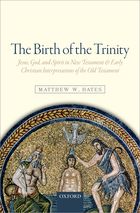
9780198729563_140This is the second in a two-part interview with Matthew Bates on his recent book The Birth of the Trinity (find the first part HERE)

Matt Bates [MB]: Matt, since you’ve read it, I’ll return the question to you?  What surprised you most?  Anything seem particularly significant to you in addition to what I’ve already mentioned?

Matt Lynch [ML]: Three things stood out to me: (1) You’ve excavated a Trinitarian reading strategy that shows enormous continuity between the NT and early Patristic eras. (2) The idea that this reading strategy goes back to Jesus himself, and in texts that many scholars attribute to the historical Jesus! (3) I loved the reading of Heb 10:6-7, and your description of the Son ‘regifting’ his body back to the Father. As you state, ‘The Father initiates the gracious gift-giving with the presentation of the incarnational body to the Son, yet the Son consummates the gift-giving by offering this very same body back to the father …’ (p.87). This puts the atoning sacrifice of Jesus on a more relational (rather than transactional) footing.

Could you give an example of prosopological exegesis of an Old Testament text?

MB: My favorite example is Romans 15:3.  Paul quotes Psalm 69, saying, “For even the Christ did not please himself, but as it is written, “The insults of those who insulted you fell upon me.”  Who has Paul identified as the speaker?  The Christ.  Who is the addressee?  God (the Father).  What’s the theodramatic setting for this speech?  Paul probably viewed the Christ as addressing these words to God the Father after his death and resurrection, once he had attained to glory at the Father’s right hand.  From that position, the Christ speaks to God about the purpose of his prior suffering, saying, “The insults of those who insulted you, O God my Father, they fell upon me on the cross.”  The implication is that Paul saw Jesus Christ’s death on the cross as purposed in part to shield God (the Father) from the insults that otherwise would have landed on God.  So, the Son tells God the Father that he acted as a substitute in his place on the cross, bearing the insults that would otherwise have landed on God.

ML: That’s a very personal insight into Trinitarian conversations … as if we’re dealing with … well … persons! If we grant Jesus’ conception of his own pre-existence, as you suggest in the book, how do you move from Jesus’ pre-existence to ontological parity with the Father and Spirit? In other words, how can we say that these theodramatic conversations reveal the birth of the Trinity, and not just belief in the pre-existence of Jesus, a divine being?

MB: Hmmm…  That is a good question.  I can only say that the answer to this question emerges mostly in the detailed interpretations in the book.  But, for instance, when we find in an example of prosopological exegesis in Acts 2:25-28 that the Father is envisioned at the Son’s right hand (reversing the normal positions), it is difficult to escape ontological conclusions entirely.   If you have any additional thoughts about this, Matt L., I’d love to hear them.

ML: Again, you’ve turned the interview around. This is against protocol! OK, I’m just going to control my temper here and answer. … I think this is where the Trinitarian approaches help each other, and in particular, models 3 & 4 mentioned above. Where I find Hurtado & Co. helpful is in understanding how Yhwh devotion was received by Jesus, and with Bauckham & Co. how Jesus does Yhwh stuff. Both of these insights suggest that early followers saw ontological parity between Jesus and Yhwh. In my mind this complements your insights into the pre-existent Jesus and intra-Trinitarian dialogue.

Your book helps give depth to our understanding of the Trinity. The Father, Son, and Spirit were seen to be in rich dialogue with one another. Do you think we can read other Old Testament texts theodramatically?

MB: I would say “yes.”  Do you?

ML: I’m not yet settled on this, at least on whether we have sufficient warrant to read any texts in such a way that they provide a previously unseen window into intra-Trinitarian dialogues. Nonetheless, your controls on reading theodramatically (ch. 7) are helpful.

What are the implications of your work for systematic theology?

MB: Well, I’ll be curious to see what the systematicians make of The Birth of the Trinity.  I do believe that my results mesh well with the traditional Nicaean-Constantinopolitan conclusion that God is three persons subsisting in one divine essence, although my work emphasizes the “persons” category.  I wonder if those favoring social models of the Trinity—that is, those who prioritize persons in relationship over one divine essence—will see my book as offering support?  I also wonder if those who emphasize the economic Trinity or the Trinity-as-revealed-in-history will find my work useful for opening up some new scriptural vistas.

Thanks, Matt L., for your excellent questions.  It’s always great to talk with you, whether in person or via the keyboard—and it has been a delight chatting with you about the book.  A final remark:  Research-writing is always arduous, but the time I spent penning The Birth of the Trinity was often an exciting and (dare I say) worshipful experience.  What pleases me most is that a number of readers and reviewers have remarked that the book has enhanced their love for the triune God.  May God be praised: Father, Son, and Spirit.

ML: Thanks Matt. Always a pleasure.

Share on Social Media:
9780198729563_450

Interview with Matthew Bates on The Birth of the Trinity – Part 1

bates-matthew9780198729563_140In this post, I interview Matthew W. Bates about his recent book, The Birth of the Trinity: Jesus, God, and Spirit in New Testament and Early Christian Interpretation of the Old Testament (Oxford University Press, 2015). Matt received his Ph.D. from Notre Dame, and has served for the past four years as Assistant Professor of Theology at Quincy University in Quincy, Illinois. In addition to his recent book on the Trinity, Matt has written a book on Paul’s method of interpreting Scripture: The Hermeneutics of the Apostolic Proclamation (Baylor University Press, 2012). He has also written articles for Journal of Biblical Literature, Revue biblique, The Catholic Biblical Quarterly, and The Journal of Theological Studies. Matt has been a good friend since we met at graduate school at Regent College, in Vancouver, B.C.

ML: Matt, thanks for being willing to do this interview with the Theological Miscellany blog.

MB: Thanks, it is a pleasure to be invited.  This is my first “author interview” so my palms are sweating.  Are you are going to hit me with a tricky question that is wrong no matter how I answer:  “So, Matt, since it is clearly heretical to think that the Trinity can be born, why are you so determined to defend this view?”—so that I fumble for words, awkwardly clear my throat, start over several times, and then finally break into tears saying that this isn’t my view at all….  Oh wait, this is a blog interview?  And I can spend as much time as I wish crafting a reply?  Oh, okay, I guess I’m not nervous anymore.

ML: Matt, I’m glad you pulled yourself together. It looked for a moment like this interview was headed for disaster! OK, what’s the big idea in your book?

MB: The big idea is that the concept of the Trinity emerged in earliest Christianity to a large degree because the first Christians were reading their Old Testament in a specific person-centered fashion.  They were in the habit of searching the OT for unmarked dialogical shifts and then seeking to tease out the identity of the speaker.  The technical term for this is prosopological exegesis (combining the Greek word “prosopon” for person or mask and “logos” for word or divine-inspiring agent).  So, the idea of Father, Son, and Spirit as distinct divine persons capable of conversing with one another in a time-transcending fashion emerged in connection with a specific reading strategy.  Christians of the New Testament era were reading their OT in such a way that God was differentiated as persons in conversation.  Moreover I think that it can be demonstrated that this divine differentiation was not an arbitrary way of reading the OT, but is a “good” reading strategy.

ML: Has anyone argued this before?

MB: Not for the earliest Christianity of the New Testament.  A few scholars of the patristic era (roughly the second to the fifth century) have suggested that prosopological exegesis was vital to Trinitarian developments (e.g., Carl Andresen, Marie-Josephe Rondeau, and Michael Slusser).  But these scholars generally begin with Tertullian and Origen and move forward in time to show how prosopological exegesis functioned in the third and fourth century and beyond.  No other full-scale study of which I am aware has ever traced this back into the NT time period.

ML: Prior to your work, what were the common historical data points for plotting the development of belief in the Trinity?

MB: The three main ways other scholars currently plot the development of the belief in the Trinity are as follows: (1) Trinitarianism by encounter with the historical Jesus—the assertion that earthly Jesus was so obviously divine that the doctrine of the Trinity more or less emerged instantly around him; (2) Trinitarianism by Hellenistic philosophical imposition—the notion that the Trinity emerged when Jewish monotheism gave way to Greek philosophical categories of thought;  (3) Trinitarianism as the outgrowth of mediated Jewish monotheism—the idea that within Judaism certain intermediaries served to broker God to the world (e.g., angels, wisdom, logos), and that as Jesus and the Spirit came to be described in terms of these intermediaries, they came to be regarded as divine.  Now within these three broad streams there are all kinds of off-shoots.  For example, Larry Hurtado insists that Jesus was worshipped from the beginning, but nevertheless mediatorial categories were important.  Meanwhile Richard Bauckham (followed by N. T. Wright and others) thinks Jesus and God shared a unique personal identity (usually called a “Christology of Divine Identity”).  So my model could be considered a new model that does not obviate, but supplements and corrects various dimensions of these other models:  (4) Trinitarianism by continuity in prosopological exegesis—that is, the reading strategy that allowed our NT authors to differentiate the one God of Israel was the same strategy used by the later Fathers of the church when they more definitively framed the doctrine of the Trinity.

ML: What is the most surprising or significant find of your book?

MB: Personally, I was surprised that the study proved to be so exegetically and theologically generative.  The NT is such heavily worked ground that it is unusual to be able to offer an interpretation of a passage that has never before been proposed by another scholar.  But numerous novel interpretations of specific biblical passages emerged.  I’ll be curious to see how other scholars assess these.

I would identify three things as especially significant: (1) a new historical model for how the doctrine of the Trinity first emerged; (2) the suggestion that “Divine Identity Christology” and other NT Christological models need to take into account NT data showing that Jesus Christ was understood to be a divine person who conversed with other divine persons—i.e., we find what I term a “Christology of Divine Persons” in the NT; (3) when Jesus Christ was regarded as speaking in the OT this wasn’t because our NT authors were reading “typologically” (contra Richard Hays) but rather prosopologically.

Part two is available here.

Share on Social Media:
face-535774_1280

Schizophrenic Jesus?

Schizophrenic Jesus?

Imagine you were facing an inquisition and, on pain of torture, mutilation, and exile, they asked you to answer the following question correctly: ‘How many ‘wills’ does Jesus have – one or two?’ Apart from thinking you’d stumbled into a Monty Python sketch, what else might go through your mind? Is that even a question? Isn’t the answer obvious? Is it a trick question? But you’re being pressed now for the correct answer – one or two? And they’re serious. So what’s your answer?

I’m guessing, if you’ve never studied theology, you’re going with one. One will. Jesus had God’s will didn’t he? He always did what the Father wanted him to do, and anyway, he was God, even though he was a man, and it makes no sense to say that he had two, so we’ll go with one. I’m saying one – one will. Am I right?

Well, if you’d given that answer to your inquisitors in Constantinople in 662 AD they’d have slapped you on the back, given you a commendation and a piece of cake and sent you on your way. You were right. Phew! That was lucky.

Only if you’d given that answer in Constantinople in 681 AD, less than 20 years later, you’d have been………..wrong. The answer was two – and it still is.

What? How and why did that happen?

This did actually happen. An elderly monk called Maximus faced a trial where he was told that if he didn’t agree with the emperor’s ruling that Jesus only had one will (a divine will), that he and his disciples would be exiled. He couldn’t agree. Maximus believed that as the incarnate Son, Jesus Christ had two wills – a divine will and a human will. He was exiled to Thrace in 655 and told to keep his subversive ideas quiet, except he didn’t. He was hauled back in 661 and cross-examined. He dug his heels in. Jesus Christ had two wills. As a punishment, he had his tongue ripped out and his right hand cut off so he could no longer speak or write his dreadful heresy. He was exiled again and died soon after on August 13th, 662. Shocking, hey?

What’s more shocking is that less than 20 years later, a council was called, and they changed their minds! Maximus was right after all. Jesus Christ had two wills – a divine will and a human one – and so it stands. No wonder he was made a saint.

There were politics involved. Of course there were politics. This time between the East and the West, the Roman and the Byzantine church, and Maximus was on the wrong side of the political divide. But it wasn’t just that. In amongst the political wranglings this was a row about who God is in Christ, and how he saves us. This is why Maximus dug his heels in, and why he was prepared to lose his precious tongue and his precious hand – all for the sake of an idea.

What is it about Christian doctrine, what we believe about God and why, that becomes a matter of life and death – literally? This is a fascinating question. In following posts, I’ll explain why Maximus was prepared to die for his idea. I’ll look at why the idea of Jesus having two wills wasn’t and still isn’t a dry and fusty academic debate, and why the Eastern church made a decision in the end that this was, in fact, the correct answer.

To read further, click HERE.

Share on Social Media: